Editor's note: Even though its summertime, news from the Microwave industry remains quite active in both military and commercial markets with announcements of contract wins, new products, M&A activity and more. We offer this light version of this weeks news as a reminder to enjoy the lazy days of summer.
From Raytheon
Stimulus money can still be found
As Raytheon breaks new ground
To deploy 700 Megahertz LTE
Dedicated to serving public safety
From Suncastle Microwave
A new antenna with decade-plus bandwidth and high gain
Will help extend the coverage range
Of UAVs on special missions
Thanks to Suncastle Microwave’s recent innovation
From L3 Telemetry-East
To ensure interoperability in aeronautical telemetry
Air Force ground receivers will get an upgrade from L3
A new IRIG standard utilizes C-band
In a down-conversion architecture used across the land.
From Tektronix
To help debug ASICs and FPGAs that are complex
Veridae Systems was acquired by Tektronix
Supporting multi-device systems with enhanced visualization
And shortening the time needed for system validation
From Integral Systems
Installation of Integral System’s SAT-DSA is now complete
And helping Elettronica Industriale of Italy to compete
Through better traffic maintenance and RF interference identification
The company can offer the best broadcast quality in that nation
From Roke Manor Research
For tactical deployments of the military kind
A portable, long range 3G base station was hard to find
Until Roke Manor launched “Battlefield Connect” for ad-hoc communications
To help spectrum overload in both peace-keeping and special operations
From Rohde & Schwarz
As TDD version of LTE fights for market share
Network providers and device OEMs must test their wares
So this week R&S and China Mobile signed an agreement
To collaborate on an end-to-end TD-LTE test environment
Friday, July 8, 2011


Thursday, July 7, 2011
ABI Research Teardown: Samsung Galaxy S II Shows Interesting RF Design-ins
I received this ABI Research promo today and found some interesting RF findings in the Samsung Galaxy S II, a new flagship member of Samsung's Android smartphone lineup. As part of its new Teardown Research Service, ABI Research has dismantled, analyzed, and tested the device down to the component level. If you are looking to keep up with the latest technology in 2011, the Galaxy S II is a good place to start.

According to ABI Research vice president of engineering James Mielke, “Samsung started from scratch with this phone: almost every component is new. Its application processor is the most powerful on the market at present. It is the first to use the Samsung Exynos 4210 dual-core application processor (a competitor to NVIDIA’s dual-core Tegra 2). The name Exynos combines Greek words for ‘smart’ and ‘green,’ indicating Samsung’s energy-efficiency goals for the design.”
Major changes include:
- Exynos dual-core apps processor. 118.8 mm2 die size with amperage specs roughly similar to the Tegra 2
- New single-packaged multi-band multi-mode PA from RFMD
- New CMOS-based antenna switch
- New lower-power XMM6260 cellular chipset from Infineon
Mielke sums up: “Samsung took many risks by combining all these new technologies into one phone. But ABI Research believes those risks will pay off; the Galaxy S II sets a new benchmark for almost every category on which a smartphone is measured.”
ABI Research’s “Samsung Galaxy S II Teardown” report provides detailed photos, process evaluation, and part descriptions for all of the major components such as power amplifier, power management, baseband processor, RF, Bluetooth, GPS, WiLAN, and many discretes. Tying all this information together are unique circuit board photos, performance measurements, cost information, and board area data.
RFMD has been promoting the use of their newer multi-band, multi-mode PAs and it has paid off in this design-in. This is the future of PAs that can support many bands with one device especially as LTE will add many new bands to the already numerous ones current phones have to support.
Microwave Journal has also reported that lower cost CMOS switches have now achieved performance on par with GaAs switches for lower power applications and would make their way into handsets very soon. And here they are!
Friday, June 24, 2011
High Capacity MM-Wave Coms: A Mid-Year Checkup
Wireless Technology Expert Jonathan Wells reports that at mid-2011 the high capacity wireless market segment continues to grow in strength. All the carriers are now advertising 4G networks and claiming super-fast download speeds. High-capacity gigabit wireless products are being deployed in both the microwave and mm-wave frequency bands to address the backhaul demands of these networks.
Over 1 million microwave radios in 2010
Although 2010 saw a drop in overall PTP radio shipments, high capacity solutions remains the shining sector. EJL Wireless reports that of the almost 1.1 million PTP radios shipped last year, 75% of them are in the high capacity product segment. Leading high capacity vendors such as Aviat Networks, Ceragon and Dragonwave all have microwave products that can now deliver almost 1 Gbps true data throughput in the regulated microwave channels.
$500+ million mm-wave market
The 60 GHz and 70/80GHz bands, which permits multi-gigabit transmission, remains the fastest growing market segment. EJL Wireless forecast radio shipments in this sector grew 67% in 2010. Leaders BridgeWave announced earlier this year that they have shipped their 10,000th mm-wave system, and have released a novel 60 GHz product for picocell backhaul. Visant Strategies have forecast that revenue from 60 GHz and 70/80 GHz PTP radios will reach over $500 million in 2016, citing growth from 4G base stations driving Gbps speed requirements in dense urban areas. Infonetics Research has published a more bullish prediction; that 70/80 GHz PTP equipment will grow to over $450 million by 2014.
For More Information
To better understand the high capacity microwave and mm-wave product landscape and the wider wireless technology implications, see his new book on “Multi-Gigabit Microwave and Millimeter-Wave Wireless Communications”. For more information, or to purchase a discounted copy of this book, click here …
Jonathan Wells, Ph.D. M.B.A.
President, AJIS LLC
Wireless Technology Consulting
Email: jonathan@ajisconsulting.com
Web: www.ajisconsulting.com
LinkedIn: www.linkedin.com/in/jonathanwells
Wednesday, June 22, 2011
GaAs and Compound Semiconductor Technologies Service (GaAs) Viewpoint
Strategy Analytics reported that recent financial reports from companies in the microelectronics portion of the compound semiconductor industry indicate continued sharp revenue growth. The Strategy Analytics GaAs and Compound Semiconductor Technologies Service (GaAs) viewpoint, “Compound Semiconductor Industry Review April 2011: Microelectronics,” reports the latest revenue results for leading companies in the microelectronics segment of the compound semiconductor industry, such as RFMD, Skyworks Solutions, Fairchild, Fujitsu, Hittite Microwave, TriQuint Semiconductor, Soitech and WIN Semiconductors.

"The strong revenue reports which Strategy Analytics saw in April show continued compound semiconductor market expansion,” noted Eric Higham, Director of the Strategy Analytics GaAs and Compound Semiconductor Technologies Service. “Growth in this industry is broadly-based as both gallium arsenide (GaAs) and silicon manufacturers are showing strong year-on-year revenue gains.”
Asif Anwar, Director, Strategy Analytics Strategic Technologies Practice added, “Increasing data consumption is driving development in consumer electronics and networks.” This viewpoint summarizes April 2011 financial, product, contract and employment developments from major GaAs and silicon suppliers, addressing a variety of commercial and military applications that require gallium arsenide (GaAs), gallium nitride (GaN), Silicon carbide (SiC) and complementary metal-oxide-semiconductor (CMOS) technologies.
Eric Higham gave us some exclusive addition information. He added the following:
In our “Compound Semiconductor Industry Review April 2011: Microelectronics” report, we captured the latest quarterly revenue reports from several of the largest compound semiconductor device manufacturers. A few trends were notable. Most of the year-on-year revenue comparisons were positive and substantial, with GaAs manufacturers Hittite and TriQuint reporting 24% growth, Skyworks reporting 37% growth and Silicon manufacturer Microsemi leading them all with 73% quarterly revenue growth. This is important because it shows the growth is broadly based, with both Silicon and GaAs suppliers demonstrating strong results. It is important to note that 2010 was a banner year for the compound semiconductor industry. Strategy Analytics believes revenue in the industry grew by 35% in 2010, so strong quarterly revenue gains in 2011 indicate continued strength in the compound semiconductor industry.
There is a cautionary note, however, and this is the second notable trend. Two of the leading GaAs suppliers in the industry, RFMD and ANADIGICS both saw year-on-year declines in quarterly revenue. Both companies attribute this to challenges at major handset customers. Previous reports from Strategy Analytics have captured how diligently compound semiconductor companies have been working to develop products for a variety of other market applications. This is certainly the case at RFMD and ANADIGICS, but it underscores how important the handset market segment is to the overall compound semiconductor industry.
Tuesday, June 21, 2011
Uplink and Downlink to Follow Two Different Technology Directions
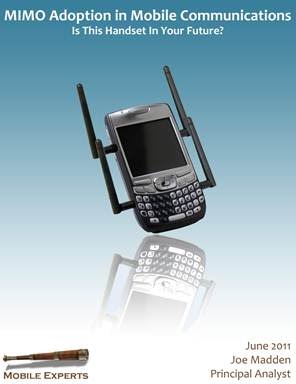
A new report released today by Mobile Experts predicts an industry shift away from the 3GPP roadmap, which calls for evolution to 8x8 MIMO (Multiple Input-Multiple Output) technology.
“Field testing has shown limited benefit from the simple addition of more antennas and early implementation of Multi-User MIMO” said Joe Madden, Principal Analyst at Mobile Experts. “Instead of blindly following the 3GPP evolution path, mobile operators are looking for different, creative ways to boost throughput and capacity. Interference cancellation and Cooperative Multipoint (CoMP), as well as advanced MU-MIMO will be important technologies during the next few years”.
“Mobile Experts is the only analyst firm that focuses on the radio chain for both infrastructure and device markets. In the case of MIMO, it is critical to examine concerns of suppliers of a huge variety of equipment, ranging from base stations and femtocells to smartphones, tablets, and PC modems. In particular, the concerns of device suppliers regarding size, battery life, and cost are crucial in the technology choices for the 2014-2016 timeframe”.
The new report, MIMO Adoption in Mobile Communications, can be found at http://www.mobile-experts.net/, and provides:
* A broad overview of the market drivers which are pushing mobile operators toward new architectures;
* Technical analysis and block diagrams for devices and infrastructure;
* Insightful analysis of:
* Infrastructure in the macro layer, including macrocells, microcells and picocells;
* Femtocell adoption of MIMO antenna techniques;
* Expected architectures for DAS, repeaters, and relays;
* Device migration from Tx and Rx diversity to higher order MIMO
* Cost vs. Benefit analysis of MIMO in:
* Handsets and other devices;
* Base stations using Remote Radio Heads (RRH)
* Forecast spreadsheets predict market size and segmentation through 2016:
* By device type (PC embedded modems, tablets, smartphones, feature phones);
* By infrastructure type (Macrocell, microcell, picocell, femtocell, DAS, repeater, relay);
* By uplink vs. downlink;
* By MIMO type (SISO, SIMO, 2x2, 4x2, 4x4, etc.);
* Predictions of alternatives to MIMO are presented.
About Mobile Experts LLC:
Mobile Experts provides insightful market analysis for the mobile infrastructure and mobile handset markets. Research topics center on technology introduction for radio frequency (RF) and communications innovation. Recent publications focus on Multi-Standard Radio Base Stations, Semiconductors for Remote Radio Heads, Outdoor DAS, In-Building Wireless, and Small Cells and HetNets.
“Field testing has shown limited benefit from the simple addition of more antennas and early implementation of Multi-User MIMO” said Joe Madden, Principal Analyst at Mobile Experts. “Instead of blindly following the 3GPP evolution path, mobile operators are looking for different, creative ways to boost throughput and capacity. Interference cancellation and Cooperative Multipoint (CoMP), as well as advanced MU-MIMO will be important technologies during the next few years”.
“Mobile Experts is the only analyst firm that focuses on the radio chain for both infrastructure and device markets. In the case of MIMO, it is critical to examine concerns of suppliers of a huge variety of equipment, ranging from base stations and femtocells to smartphones, tablets, and PC modems. In particular, the concerns of device suppliers regarding size, battery life, and cost are crucial in the technology choices for the 2014-2016 timeframe”.
The new report, MIMO Adoption in Mobile Communications, can be found at http://www.mobile-experts.net/, and provides:
* A broad overview of the market drivers which are pushing mobile operators toward new architectures;
* Technical analysis and block diagrams for devices and infrastructure;
* Insightful analysis of:
* Infrastructure in the macro layer, including macrocells, microcells and picocells;
* Femtocell adoption of MIMO antenna techniques;
* Expected architectures for DAS, repeaters, and relays;
* Device migration from Tx and Rx diversity to higher order MIMO
* Cost vs. Benefit analysis of MIMO in:
* Handsets and other devices;
* Base stations using Remote Radio Heads (RRH)
* Forecast spreadsheets predict market size and segmentation through 2016:
* By device type (PC embedded modems, tablets, smartphones, feature phones);
* By infrastructure type (Macrocell, microcell, picocell, femtocell, DAS, repeater, relay);
* By uplink vs. downlink;
* By MIMO type (SISO, SIMO, 2x2, 4x2, 4x4, etc.);
* Predictions of alternatives to MIMO are presented.
About Mobile Experts LLC:
Mobile Experts provides insightful market analysis for the mobile infrastructure and mobile handset markets. Research topics center on technology introduction for radio frequency (RF) and communications innovation. Recent publications focus on Multi-Standard Radio Base Stations, Semiconductors for Remote Radio Heads, Outdoor DAS, In-Building Wireless, and Small Cells and HetNets.
Sunday, June 12, 2011
Interesting Products at IMS2011
After crusing around the inner harbor (aka the exhibition floor) for three days, here is a quick rundown of some interesting products we came across:
- Agilent's integrated vector signal generator up to 44 GHz and analog signal generator up to 67 GHz (operational to 70 GHz), and the first microwave analog signal generator to break the 1 W output power barrier.
- Anritsu introduced a new broadband VNA system that provides single-sweep coverage from 70 kHz to 110 GHz with operation from 40 kHz to 125 GHz, and utilizes an advanced design that eliminates the need for large, heavy mmWave modules and coax combiners.
- R&S introduced a network analyzer with dynamic range up to 140 dB, sweept time of 4 ms with 401 pts
- Hittite's 33 news products (too many to cover here) which is unique for a company of this size
- M/A-COM's new family of GaN products covering L- and S-bands with much better efficiency and power than their BiPolar products
- Avago introduced the first front end module designed specifically for coexistence operation of WiMAX with other cellular and WiFi radios in the same device
- NXP's 1200 W ISM LDMOS transistor that can widthstand a VSWR of 125:1 and still operate
- Peregrine's digitally controlled variable capacitors targeting 100 MHz to 3 GHz applications
- Crane's Multi-Mix technology that creates multilayer integrated microwave circuits and modules using direct bonding of low cost composite substrates reducing cost, weight and size
- Skyworks ceramic based high power filters offering size and weight improvements over metal cavity based filters
- RFMD's upcoming Si SOI and GaN switches should be exciting to see
- ADI's new PLL synthesizer operating from 35 to 4400 MHz with rms jitter of .3 ps and typ EVM of .4% at 2.1 GHz
A couple of new finds were:
- Daisy RS wireless portable power meters using 2.4 GHz wireless links up to 100 meters
- Octane Wearable antennas using flexible antenna technology that allows them to be woven into many shapes and sizes for applications for soldiers, first responders, security/intelligence and more
Let me know what new things you saw at the IMS2011.
- Agilent's integrated vector signal generator up to 44 GHz and analog signal generator up to 67 GHz (operational to 70 GHz), and the first microwave analog signal generator to break the 1 W output power barrier.
- Anritsu introduced a new broadband VNA system that provides single-sweep coverage from 70 kHz to 110 GHz with operation from 40 kHz to 125 GHz, and utilizes an advanced design that eliminates the need for large, heavy mmWave modules and coax combiners.
- R&S introduced a network analyzer with dynamic range up to 140 dB, sweept time of 4 ms with 401 pts
- Hittite's 33 news products (too many to cover here) which is unique for a company of this size
- M/A-COM's new family of GaN products covering L- and S-bands with much better efficiency and power than their BiPolar products
- Avago introduced the first front end module designed specifically for coexistence operation of WiMAX with other cellular and WiFi radios in the same device
- NXP's 1200 W ISM LDMOS transistor that can widthstand a VSWR of 125:1 and still operate
- Peregrine's digitally controlled variable capacitors targeting 100 MHz to 3 GHz applications
- Crane's Multi-Mix technology that creates multilayer integrated microwave circuits and modules using direct bonding of low cost composite substrates reducing cost, weight and size
- Skyworks ceramic based high power filters offering size and weight improvements over metal cavity based filters
- RFMD's upcoming Si SOI and GaN switches should be exciting to see
- ADI's new PLL synthesizer operating from 35 to 4400 MHz with rms jitter of .3 ps and typ EVM of .4% at 2.1 GHz
A couple of new finds were:
- Daisy RS wireless portable power meters using 2.4 GHz wireless links up to 100 meters
- Octane Wearable antennas using flexible antenna technology that allows them to be woven into many shapes and sizes for applications for soldiers, first responders, security/intelligence and more
Let me know what new things you saw at the IMS2011.
Wednesday, June 8, 2011
IMS2011 First Impressions
 The Baltimore inner harbor area is a beautiful setting for the IMS2011 and certainly convenient for us on the east coast. The sessions are in full swing with some very interesting topics being presented. I see trends in very high efficiency amplifiers with better modeling/measurement techniques, new packaging techniques from LCP to fusion bonded laminates, very wideband active devices to cover multiple frequency bands, highly integrated modules that solve co-existence problems, new signal generators that provide real life signal replication and storage and more.
The exhibition is very lively and positive - attendance looks very good this year. The MicroApps sessions seem to get better each year with more companies participating. Our Nonlinear Expert Forum is today at noon in the MicroApps featuring experts sponsored by Agilent, R&S, Anritsu and Tektronix. Some products that caught my eye so far are Agilent's new signal generator that eliminates expensive flight testing, Avago's highly integrated co-existence WiFi/WiMAX module (only 5 x 7 mm), Crane's new MultiMix laminate process to realize highly integrated circuits and modules, Freescale's ever improving LDMOS products with 65:1 VSWR on a low frequency device and improved video bandwidth on their cellular band products, IHP's (Germany) 500 GHz fmax SiGe process and Peregrine's digitally tunable capcitors.
 Yesterday we attended the Women in Microwaves reception at the Hilton which is growing each year and then made our way down to the inner harbor for the MWJ customer appreciation party at the Tir Na Nog. It has a nice deck overlooking the harbor with great beers and a nice buffet. I hope everyone who attended had a good time.
Let us know what you have seen around the show and in the technical sessions.
Friday, June 3, 2011
Heading Off to IMS2011 in Baltimore
The "dance card" is full (actually overflowing) and the pre-show coverage, articles, May show issue and Online Show Daily are ready. Our Online Show Daily page will be updated each day (or even more often) with the latest news items and features a real-time Twitter Feed, blog updates, exclusive show articles and chair message plus will have pictures and videos just following the show.
The biggest surprise leading up the show for me was all the acquisitions (Skyworks acquired SiGe and Advanced Analogic Tech plus NI acquired AWR and Phase Matrix). In addition, the abundance of news items and new product releases has already been at the highest level that I can remember which should make for an interesting show.
Microwave Journal will host the MicroApps Nonlinear Characterization Forum on Wed at noon which will be webcast live from the event. After the experts from Agilent, Anritsu, R&S (NMDG) and Tektronix (Cardiff Univ) speak, there will be a Q&A session with both the live and virtual audiences, a first for IMS.
The Plenary Session will be given by Dr. Rhodes, "Migration of WCDMA and 4G LTE Into Existing Cellular Bands". Our May Cover Story was about the history of filter companies in the Maryland area and mentions Dr. Rhodes' accomplishments in this area. The closing keynote session is given by Dr. Guerci who is an expert on Cognitive Radar and was the author of our Cover Story in Jan this year.
It should be an exciting show this year and it is a nice short flight for us from the Boston area. Let us know how you are making out at the show and if you have any exciting news.
The biggest surprise leading up the show for me was all the acquisitions (Skyworks acquired SiGe and Advanced Analogic Tech plus NI acquired AWR and Phase Matrix). In addition, the abundance of news items and new product releases has already been at the highest level that I can remember which should make for an interesting show.
Microwave Journal will host the MicroApps Nonlinear Characterization Forum on Wed at noon which will be webcast live from the event. After the experts from Agilent, Anritsu, R&S (NMDG) and Tektronix (Cardiff Univ) speak, there will be a Q&A session with both the live and virtual audiences, a first for IMS.
The Plenary Session will be given by Dr. Rhodes, "Migration of WCDMA and 4G LTE Into Existing Cellular Bands". Our May Cover Story was about the history of filter companies in the Maryland area and mentions Dr. Rhodes' accomplishments in this area. The closing keynote session is given by Dr. Guerci who is an expert on Cognitive Radar and was the author of our Cover Story in Jan this year.
It should be an exciting show this year and it is a nice short flight for us from the Boston area. Let us know how you are making out at the show and if you have any exciting news.
Wednesday, June 1, 2011
New TASC Report Defines Cyber Vulnerabilities
A new report published by TASC, Inc. examines today’s key cyber threats facing the United States and highlights the deep interrelatedness of the challenges facing the nation. As the White House and Congress consider cybersecurity legislation to protect the nation’s cyber systems, there is an urgent need for better coordination and cooperation across government and industry.
“The integration of the Internet into critical operational structures of all levels of the government, the military and the nation’s economy has created a collective reliance on information technology that will only increase in the coming years,” says Steve Winterfeld, cyber technical lead at TASC. “Today the growing dangers of cyber warfare present a new national threat—one that demands a national commitment.”
The report, “Understanding Today’s Cyber Challenges,” groups the nation’s primary cyber threats into three categories: psychologically driven cyber challenges, process-driven challenges and technologically driven cyber challenges. These challenges range in severity from those that can be quickly and easily addressed to those that require sustained, long-term investment.
“Daily security breaches threaten everyone who operates in cyberspace,” says Winterfeld. “We face more devastating attacks as cyber thieves, nation-states and others become increasingly sophisticated in their knowledge of today’s networks.”
Government agencies and businesses can use the TASC report as a tool to categorize risks and mitigation practices most relevant and appropriate to their organizations. The study was produced in collaboration with the University of Virginia.
“Before 9/11, no one imagined an attack of such magnitude could happen anywhere, especially on U.S. soil,” says Winterfeld. “The threat of a cyber calamity of similar proportions is real, and such an attack would have far-reaching impacts at every level of our society. We urgently need to reach a common understanding of what those threats are and do what we can to mitigate them.”
To download a free copy of the report, or to learn more about TASC, visit http://www.tasc.com.
“The integration of the Internet into critical operational structures of all levels of the government, the military and the nation’s economy has created a collective reliance on information technology that will only increase in the coming years,” says Steve Winterfeld, cyber technical lead at TASC. “Today the growing dangers of cyber warfare present a new national threat—one that demands a national commitment.”
The report, “Understanding Today’s Cyber Challenges,” groups the nation’s primary cyber threats into three categories: psychologically driven cyber challenges, process-driven challenges and technologically driven cyber challenges. These challenges range in severity from those that can be quickly and easily addressed to those that require sustained, long-term investment.
“Daily security breaches threaten everyone who operates in cyberspace,” says Winterfeld. “We face more devastating attacks as cyber thieves, nation-states and others become increasingly sophisticated in their knowledge of today’s networks.”
Government agencies and businesses can use the TASC report as a tool to categorize risks and mitigation practices most relevant and appropriate to their organizations. The study was produced in collaboration with the University of Virginia.
“Before 9/11, no one imagined an attack of such magnitude could happen anywhere, especially on U.S. soil,” says Winterfeld. “The threat of a cyber calamity of similar proportions is real, and such an attack would have far-reaching impacts at every level of our society. We urgently need to reach a common understanding of what those threats are and do what we can to mitigate them.”
To download a free copy of the report, or to learn more about TASC, visit http://www.tasc.com.
Wednesday, May 25, 2011
Advice for IMS2011?
There's only 12 days left until IMS2011 in Baltimore. I've been looking forward to this event since I was hired as MWJ's staff editor in April. But as the event draws near, I am starting to think about what I need to do to prepare and what my strategy should be for getting the most out of the show. Publisher Car Sheffres has already given me some good advice -- don't buy a new pair of shoes the day before the trip. Carl told me he did just that before his first trade show (in 1988 in NYC) and ended up spending every night in his hotel room with his shoes off and his aching feet up. If anyone has any more advice about getting ready for the show, please comment.
Unmanned US Military Expenditures to Total $64 billion by 2021
Strategy Analytics reports that the success of unmanned aerial systems (UAS) in providing real-time information to military commanders has contributed to both mission effectiveness and personnel protection. Despite budgetary pressures, a number of factors will help drive demand. The Strategy Analytics Advanced Defense Systems (ADS) service forecasts that US expenditure for military unmanned aerial platforms is approaching $64 billion, cumulatively, over the 2011 to 2021 timeframe, as described in the report, “US DoD Budget Implications for UAS Electronics Demand.”
While the global economic crisis has led to a reexamination of defense budgets, there remains concern for improved battle space integration, leading to support for the development of UCAV (Unmanned Combat Aerial Vehicles) platforms. This, in turn, will drive growth in the demand for EO-IR (electro-optic/infrared), radar, communications and EW (electronic warfare) systems and other associated electronics.
“Strategy Analytics analysis indicates that the UAS segment will maintain a growth trajectory, accounting for 31 percent of US DoD budget expenditure on aircraft platforms by 2021,” noted Asif Anwar, Director, Advanced Defense Systems. “The US military market for UAS platforms will grow at a compound annual growth rate of 3 percent over 2011 – 2021.”
Eric Higham, ADS Service Director, North America, added, “EO-IR payloads for intelligence, surveillance and reconnaissance (ISR), as well as radar and communications, represented 75 percent of military electronics demand in 2010, which Strategy Analytics projects will grow to 80 percent by 2021. This will create a cumulative market opportunity approaching $21 billion.”
One example is the Boeing Phantom Ray UAS which successfully completed its first flight April 27 at NASA'sDryden Flight Research Center
While the global economic crisis has led to a reexamination of defense budgets, there remains concern for improved battle space integration, leading to support for the development of UCAV (Unmanned Combat Aerial Vehicles) platforms. This, in turn, will drive growth in the demand for EO-IR (electro-optic/infrared), radar, communications and EW (electronic warfare) systems and other associated electronics.
“Strategy Analytics analysis indicates that the UAS segment will maintain a growth trajectory, accounting for 31 percent of US DoD budget expenditure on aircraft platforms by 2021,” noted Asif Anwar, Director, Advanced Defense Systems. “The US military market for UAS platforms will grow at a compound annual growth rate of 3 percent over 2011 – 2021.”
Eric Higham, ADS Service Director, North America, added, “EO-IR payloads for intelligence, surveillance and reconnaissance (ISR), as well as radar and communications, represented 75 percent of military electronics demand in 2010, which Strategy Analytics projects will grow to 80 percent by 2021. This will create a cumulative market opportunity approaching $21 billion.”
One example is the Boeing Phantom Ray UAS which successfully completed its first flight April 27 at NASA's
Tuesday, May 24, 2011
Comparing Active and Passive Mixers with Besser Associates
In a recent webinar, one of the attendees commented that Besser Instructor Allen Podell was presenting results based on "rather wimpy performance assumptions" for his active mixer versus passive mixer comparison (see below) and suggested using newer active mixers such as ADL5801 or LT5557 from ADI or LTC? This attendee asserted that mixers based on these particular devices compete very well with the best passive mixers. Allen took up this challenge and did a little investigation. His response is below.

Post-webinar response from Allen Podell -
First of all, I must admit that it is true that the ADL5801 and the LT5557 mixers mentioned were quite comparable in performance to the combination of the passive mixer and IF amplifier given as an example. Let me point out that the power consumed by the amplifier in the example was about 10% of the example HDR mixers. My statement was that Gilbert Cell active mixers were inferior in dynamic range, based on their figure of merit. Even 10 of the Avago mixers would not have been as good as the course example, at a much high dc power consumption. Are the ADL and LT active HDR mixers truly Gilbert Cell mixers, as the Avago part is?
I tried to research the Analog Devices and Linear Technology recent patents to determine the design used in these mixers, but could not find an answer. Eliminating the common emitter amplifier stages and replacing them with a transformer would improve the performance of the active mixer, but it would no longer be a Gilbert Cell mixer. Had I used in my example a feedback IF amplifier running 80 mA and a Peregrine FET mixer together, we could have built an HDR mixer about 10 dB better than that of the example.
We could then re-start the mixer war.
To view the original webinar go to: http://www.mwjournal.com/WebinarBesser_May17
Post-webinar response from Allen Podell -
First of all, I must admit that it is true that the ADL5801 and the LT5557 mixers mentioned were quite comparable in performance to the combination of the passive mixer and IF amplifier given as an example. Let me point out that the power consumed by the amplifier in the example was about 10% of the example HDR mixers. My statement was that Gilbert Cell active mixers were inferior in dynamic range, based on their figure of merit. Even 10 of the Avago mixers would not have been as good as the course example, at a much high dc power consumption. Are the ADL and LT active HDR mixers truly Gilbert Cell mixers, as the Avago part is?
I tried to research the Analog Devices and Linear Technology recent patents to determine the design used in these mixers, but could not find an answer. Eliminating the common emitter amplifier stages and replacing them with a transformer would improve the performance of the active mixer, but it would no longer be a Gilbert Cell mixer. Had I used in my example a feedback IF amplifier running 80 mA and a Peregrine FET mixer together, we could have built an HDR mixer about 10 dB better than that of the example.
We could then re-start the mixer war.
To view the original webinar go to: http://www.mwjournal.com/WebinarBesser_May17
Monday, May 23, 2011
JSF Makes First Public Fly Over Appearance
The Joint Strike Fighter, F-35C version, made its first public appearance this past weekend at Andrew's Air Force Base in Maryland. The flyover on Saturday originated from the F-35C's primary test site at Naval Air Station Patuxent River , Maryland
The F-35C is a 5th generation strike fighter with stealth capability and has larger wing surfaces and reinforced landing gear for the demanding carrier environment for the Navy. The Lockheed Martin F-35 Lightning II Joint Strike Fighter program is in the system development and demonstration phase, focusing on delivering three different and new aircraft variants to the US Marine Corps, Navy and Air Force and NATO.
This is an important program for RF/microwave companies as many of them are involved in the radar and EW systems development and production. It is one of the few programs that has some potential for a large number of units as the F-22 production quantities have been cut many times of recent years.
The F-35C is a 5th generation strike fighter with stealth capability and has larger wing surfaces and reinforced landing gear for the demanding carrier environment for the Navy. The Lockheed Martin F-35 Lightning II Joint Strike Fighter program is in the system development and demonstration phase, focusing on delivering three different and new aircraft variants to the US Marine Corps, Navy and Air Force and NATO.
This is an important program for RF/microwave companies as many of them are involved in the radar and EW systems development and production. It is one of the few programs that has some potential for a large number of units as the F-22 production quantities have been cut many times of recent years.
Friday, May 20, 2011
Anritsu Techtime Tour Visits Boston Area
 I attended the Anritsu Techtime Tour this week (co-sponsored by AWR) since it was in our neighborhood in Chelmsford, MA. The Techtime Tour is a complimentary full-day educational seminar focused on the applications of Vector Network Analyzers (VNAs). Presentations included both lecture and live demonstrations presented by industry experts and allowed everyone to ask questions.
The topics covered were:
- VNA Fundamentals
- Advanced Amplifier Design and Test Including Nonlinear Measurements
- Advanced Time Domain Techniques
- Co-Simulation with Real-Time Channel Measurements
 The session covered everything from the basics to the more advanced subjects in the afternoon so there was something for everyone. This was the last stop of the 6 city tour which included 2 stops in CA, 2 in TX, NJ and the Greater Boston. There are typically around 50 people who attend these sessions and if this tour is successful, they will try to continue having them from time to time.
I met one very interesting guy there who had his own personal VNA in his backpack. I was curious to see what he was using and he told me it was a VNWA which can be purchased as an assembled kit online for about 400 pounds from SDR-kits.net in the UK. It works up to about 1.3 GHz and he showed me the unit in action by measured a homemade filter he had rigged up. It is only 10.4 x 8 x 4.6 cm weighing 0.2 kg. A far cry from the VNAs sold by Anritsu but it is an interesting product.
Anritsu does have a big announcement for its VNA product line being released for IMS MTT-S so catch the news on the MWJ Online Show Daily.
Friday, May 13, 2011
MWJ Article Forecasts Technology used to Report Bin Laden Operation
Around the time last year when the Obama administration was first learning about bin Laden’s where-abouts in Abbottabad Pakistan, we at the Journal were putting the final touches on  our August Military Microwave supplement. While the Journal and its staff has no obvious connection to the administration, military and intelligence community behind this successful covert operation, we do have a connection to this story by way of an article we were about to publish that month. The previous fall at the Milcom show in Boston, I had read an article by Dr. Simon et. al. of Queen’s University in Belfast on millimeter-wave ad hoc personal communication system for war fighters. I had invited Dr. Cotton to author the cover story for our Military supplement and he along with William Scanlon (Queen's University of Belfast), Efstratios Skafidas (University of Melbourne) and Bhopinder Madahar (Ministry of Defence, UK) graciously accepted our offer. The article was entitled, “Millimeter-wave Stealth Radio for Special Operations Forces”.
The Abstract read as follows:
For Special Operations Forces, an important attribute of any future radio will be the ability to conceal transmissions from the enemy while transmitting large amounts of data for situational awareness and communications. These requirements will mean that military wireless systems designers will need to consider operating frequencies in the mm-wave bands. The high data rates that are achievable at these frequencies and the propagation characteristics at this wavelength will provide many benefits for the implementation of ëstealth radioí. This article discusses some of the recent advances in RF front-end technology, alongside physical layer transmission schemes that could be employed for millimeter-wave soldier-mounted radio. The operation of a hypothetical millimeter-wave soldier-to-soldier communications system that makes use of smart antenna technology is also described.
I thought of these high speed data communication networks when I heard that the White House and operation leaders were watching the action in Pakistan unfold in real-time. After years of developing microwaves for weapon systems created and used during the Cold War, perhaps older Microwave Journal readers are well accustomed to knowing the technology story behind the headlines, but it still gives me the chills when it happens. I invite everyone to go back and read Dr. Cotton’s article now that it has moved from science fiction to forecast to fact.
 our August Military Microwave supplement. While the Journal and its staff has no obvious connection to the administration, military and intelligence community behind this successful covert operation, we do have a connection to this story by way of an article we were about to publish that month. The previous fall at the Milcom show in Boston, I had read an article by Dr. Simon et. al. of Queen’s University in Belfast on millimeter-wave ad hoc personal communication system for war fighters. I had invited Dr. Cotton to author the cover story for our Military supplement and he along with William Scanlon (Queen's University of Belfast), Efstratios Skafidas (University of Melbourne) and Bhopinder Madahar (Ministry of Defence, UK) graciously accepted our offer. The article was entitled, “Millimeter-wave Stealth Radio for Special Operations Forces”.
The Abstract read as follows:
For Special Operations Forces, an important attribute of any future radio will be the ability to conceal transmissions from the enemy while transmitting large amounts of data for situational awareness and communications. These requirements will mean that military wireless systems designers will need to consider operating frequencies in the mm-wave bands. The high data rates that are achievable at these frequencies and the propagation characteristics at this wavelength will provide many benefits for the implementation of ëstealth radioí. This article discusses some of the recent advances in RF front-end technology, alongside physical layer transmission schemes that could be employed for millimeter-wave soldier-mounted radio. The operation of a hypothetical millimeter-wave soldier-to-soldier communications system that makes use of smart antenna technology is also described.
I thought of these high speed data communication networks when I heard that the White House and operation leaders were watching the action in Pakistan unfold in real-time. After years of developing microwaves for weapon systems created and used during the Cold War, perhaps older Microwave Journal readers are well accustomed to knowing the technology story behind the headlines, but it still gives me the chills when it happens. I invite everyone to go back and read Dr. Cotton’s article now that it has moved from science fiction to forecast to fact.

Monday, May 9, 2011
Stealth Technology is Being Applied Everywhere
 We learned last week that Navy SEALs probably used advanced technology on the Sikorsky choppers used in the raid on Osama bin Laden's compound in Pakistan. Military aviation experts have been poring over photographs of the debris (photo courtesy of Reuters), particularly the tail section, of the Black Hawk that had a hard landing and was purposely destroyed to protect its technology.
Exactly how the Black Hawk helicopters were modified is not completely known, but the photographs of the wreckage offer new clues to the military's cutting-edge methods. Several analysts agreed the aircraft used technology that appeared to stem from the Comanche, a $39 billion, joint project between Sikorsky and Boeing until it was scrapped in 2004 due to high costs. The tail rotor was modified with a dish covering part of the rotor to suppress noise and the tail section was modified to reduce it radar cross section. In addition, there was evidence of radar absorbing materials being used on the Black Hawks.
 Also last week, Boeing announced that its Phantom Ray unmanned airborne system (UAS) successfully completed its first flight April 27 at NASA's Dryden Flight Research Center at Edwards Air Force Base, Calif. This is a stealth unmanned platform which is obvious from its shape. The 17-minute flight took place following a series of high-speed taxi tests in March that validated ground guidance, navigation and control and verified mission planning, pilot interface and operational procedures. Phantom Ray flew to 7,500 feet and reached a speed of 178 knots.
The flight demonstrated Phantom Ray's basic airworthiness, setting the stage for additional flights in the next few weeks. These company-funded flights will prepare Phantom Ray to support potential missions that may include intelligence, surveillance and reconnaissance; suppression of enemy air defenses; electronic attack; strike; and autonomous air refueling.
Stealth technology is being applied to most combat aircraft built in the US these days, so it is a pretty safe prediction that all future US combat aircraft will be built using stealth technology and might even be all unmanned going forward.
Friday, May 6, 2011
Can RF Benefit from 3D Transistor Technology?
The buzz this week was of course the big announcement from Intel that all their new processors will use 3D transistor technology. Their "Tri-Gate" transistor that will allow the company to keep shrinking chips and keep up with Moore's Law which for a while looked to be an impossibility in the near future. Intel says the transistors will use 50 percent less power, conduct more current and provide 37 percent more speed than their 2D transistors while only adding an estimated 2-3 percent cost to existing silicon wafers. This isn't future technology any more as Intel says the it will be used its 22nm Ivy Bridge CPUs, going into mass production in the second half of the year and going forward on future platforms.
If you have not already seen it, the Tri-Gate transistor is really a FinFET which was invented about 10 years ago. The gate metal wraps around the active channel on three sides of the fin like structure of Si allowing it to better control the current. It has less leakage in the off state and allows better current flow in the on state making the FET more efficient. Here is the nice video Intel released showing how it works.
FinFET transistors suffer from stronger device parasitics compared to planar bulk transistors and tend to have lower cutoff frequencies. However, the improved performance of FinFET transistors is motivation for more work in this area, especially for reducing power consumption. There have been some papers on RF FinFETs - many of them on dual gate structures instead of Tri-Gate but the results seem limited. Has anyone seen some more recent work with RF FinFETs/Tri-Gate devices?
If you have not already seen it, the Tri-Gate transistor is really a FinFET which was invented about 10 years ago. The gate metal wraps around the active channel on three sides of the fin like structure of Si allowing it to better control the current. It has less leakage in the off state and allows better current flow in the on state making the FET more efficient. Here is the nice video Intel released showing how it works.
FinFET transistors suffer from stronger device parasitics compared to planar bulk transistors and tend to have lower cutoff frequencies. However, the improved performance of FinFET transistors is motivation for more work in this area, especially for reducing power consumption. There have been some papers on RF FinFETs - many of them on dual gate structures instead of Tri-Gate but the results seem limited. Has anyone seen some more recent work with RF FinFETs/Tri-Gate devices?
Monday, May 2, 2011
Weather Radar Technology Captures Tornado Activity
The devastating tornadoes last week were tragic, but I saw some amazing photos of the intense storms while watching the news. Many of these photos and animations are enabled by advanced radar technologies that our industry has developed.
One NASA platform that provided vital information is the Tropical Rainfall Measuring Mission (TRMM). The TRMM has several instruments including a Precipitation Radar that was the first space borne instrument designed to provide 3D maps of storm structure. These measurements yield information on the intensity and distribution of the rain, on the rain type, on the storm depth and on the height at which the snow melts into rain. It can provide vertical profiles up to 12 miles and detect fairly light rain rates down to about .027 inches per hour. The Precipitation Radar uses a frequency 3 times higher than similar ground based systems in order to obtain high resolution images. It uses 128 solid state power amplifiers to provide a robust design and minimize power consumption (it only uses 224 W). As the beam size is small, it also utilizes scanning phased array technology to steer the beam over the target area.
The TRMM also has a Microwave Imager (TMI) whichi is a passive microwave sensor designed to provide quantitative rainfall information over a wide swath under the TRMM satellite. By carefully measuring the minute amounts of microwave energy emitted by the Earth and its atmosphere, TMI is able to quantify the water vapor, the cloud water, and the rainfall intensity in the atmosphere. The TMI measures the intensity of radiation at five separate frequencies: 10.7, 19.4, 21.3, 37 and 85.5 GHz. Calculating rainfall rates from TMI requires fairly complicated calculations using Planck’s radiation law, which describes how much energy a body radiates given its temperature.
The primary instruments for measuring precipitation are the Precipitation Radar, the TMI, and the Visible and Infrared Scanner. Additionally, TRMM carries the Lightning Imaging Sensor and the Clouds and the Earth’s Radiant Energy System Instrument. These instruments can all function individually or in combination with one another. TRMM is part of NASA’sMission

The TRMM satellite saw severe weather over the easternUnited States Louisiana to the Ohio Alabama and Mississippi (
Ground radar systems have added the capability to create very detailed 3D images of severe weather. One reason for this is the use of dual polarization radar. The images and descriptions below were taken from an article written by Jason Samenow in the Washington Post:

Radar sequence of tornado supercell thunderstorms that tracked from westernMississippi into southwest North Carolina National Center
It is a Radar montage of the most impressive supercell from the large tornado outbreak. This cell traveled about 450 miles and lasted over 8 hours. It also was responsible for the large, violent tornado that caused the destruction inTuscaloosa Tuscaloosa to Birmingham

Vertical cross section of radar when tornado was in the vicinity ofTuscaloosa
The above three-dimensional radar image shows not only the hook echo across the horizontal plane but also see the “debris” generated by the tornado right as it’s in the vicinity of Tuscaloosa. The debris is depicted by the “ball” of pink (indicating the high reflectivity) at the point of the hook echo. In the vertical, you can see the radar’s reflection of the actual funnel.
These newer tools should help scientists learn more about these storms and improve our warning systems. All these images and capabilities enabled by RF engineering!
One NASA platform that provided vital information is the Tropical Rainfall Measuring Mission (TRMM). The TRMM has several instruments including a Precipitation Radar that was the first space borne instrument designed to provide 3D maps of storm structure. These measurements yield information on the intensity and distribution of the rain, on the rain type, on the storm depth and on the height at which the snow melts into rain. It can provide vertical profiles up to 12 miles and detect fairly light rain rates down to about .027 inches per hour. The Precipitation Radar uses a frequency 3 times higher than similar ground based systems in order to obtain high resolution images. It uses 128 solid state power amplifiers to provide a robust design and minimize power consumption (it only uses 224 W). As the beam size is small, it also utilizes scanning phased array technology to steer the beam over the target area.
The TRMM also has a Microwave Imager (TMI) whichi is a passive microwave sensor designed to provide quantitative rainfall information over a wide swath under the TRMM satellite. By carefully measuring the minute amounts of microwave energy emitted by the Earth and its atmosphere, TMI is able to quantify the water vapor, the cloud water, and the rainfall intensity in the atmosphere. The TMI measures the intensity of radiation at five separate frequencies: 10.7, 19.4, 21.3, 37 and 85.5 GHz. Calculating rainfall rates from TMI requires fairly complicated calculations using Planck’s radiation law, which describes how much energy a body radiates given its temperature.
The primary instruments for measuring precipitation are the Precipitation Radar, the TMI, and the Visible and Infrared Scanner. Additionally, TRMM carries the Lightning Imaging Sensor and the Clouds and the Earth’s Radiant Energy System Instrument. These instruments can all function individually or in combination with one another. TRMM is part of NASA’s

The TRMM satellite saw severe weather over the eastern
Ground radar systems have added the capability to create very detailed 3D images of severe weather. One reason for this is the use of dual polarization radar. The images and descriptions below were taken from an article written by Jason Samenow in the Washington Post:

Radar sequence of tornado supercell thunderstorms that tracked from western
It is a Radar montage of the most impressive supercell from the large tornado outbreak. This cell traveled about 450 miles and lasted over 8 hours. It also was responsible for the large, violent tornado that caused the destruction in

Vertical cross section of radar when tornado was in the vicinity of
The above three-dimensional radar image shows not only the hook echo across the horizontal plane but also see the “debris” generated by the tornado right as it’s in the vicinity of Tuscaloosa. The debris is depicted by the “ball” of pink (indicating the high reflectivity) at the point of the hook echo. In the vertical, you can see the radar’s reflection of the actual funnel.
These newer tools should help scientists learn more about these storms and improve our warning systems. All these images and capabilities enabled by RF engineering!
Monday, April 18, 2011
M2M App Developers Projected to See Lower Module Prices
According to ABI Research, Mobile operators AT&T and Sprint have recently struck deals with cellular embedded module vendors to provide modules for M2M (machine-to-machine) application developer partners at discounted rates. Their goal is to encourage app developers to embrace 3G – and now 4G – M2M modules.
The M2M market largely consists of low data rate, low data consumption applications where 2G technology is perfectly adequate. Given a choice, M2M application developers would prefer to stay with older technology that is not only adequate from a connectivity standpoint, but more optimized from a cost component standpoint. In 2010, a 2G GSM/GPRS cellular embedded module cost approximately $18, while a 3G WCDMA module was roughly $65.
ABI Research forecasts that as WCDMA module shipments grow from less than four million last year to more than 62 million in 2016, ASPs will fall by more than half, approaching $30 in 2016. According to ABI Research practice director Sam Lucero, “The operator-module vendor deals we are seeing today may cause that ASP to be reached much sooner for the overall WCDMA market.”
The operators, in contrast, want all data devices on the network to use the most spectrally efficient technology – 3G or even 4G rather than 2G. “It makes sense for the mobile operators to do whatever they can to facilitate adoption of 3G/4G technology by the M2M ecosystem,” notes Lucero. “The AT&T/Sprint deals are examples of just such symbiosis: large mobile operators using their size to benefit typically much smaller M2M application developers.”
AT&T is working with Ericsson, Huawei and ZTE (the latter two being leading China-based module vendors) while Sprint has selected Fusion Wireless, an innovative new CDMA-focused module vendor based in
I still think companies deploying these systems will be very cost driven so it will be a hard sell for the operators to force companies to use newer technology where the module cost will always be higher. The incentives will have to be substantial for them to adopt 3G/4G technology.
Tuesday, April 12, 2011
FCC Decision Could Lead to Interference Among GPS Receivers
Coalition Warns Recent FCC Decision Could Harm U.S. Economy and Exports. Threat of GPS Interference Could Have Unintended Consequences
As the House Energy and Commerce Subcommittee on Communications and Technology begins its in-depth examination of spectrum issues, the Coalition to Save Our GPS submitted a detailed statement warning that a recent FCC decision that may disrupt the Global Positioning System(GPS) could have the unintended consequence of giving the Chinese, Russians, and Europeans competitive and economic advantage over the United States.
The “Coalition to Save Our GPS” is working to resolve a serious threat to the Global Positioning System. The threat stems from a recent decision by the FCC to grant a conditional waiver allowing the dramatic expansion of terrestrial use of the satellite spectrum immediately neighboring that of GPS, potentially causing interference to millions of GPS receivers. The FCC granted the conditional waiver for a proposal to build 40,000 ground stations to a company called LightSquared.
A portion of the Coalition’s statement follows:
“The Global Positioning System has stimulated a multi-billion dollar global industry that contributes both to the domestic economy and to U.S. exports. However, the Chinese, Russians, and Europeans are all developing their own GPS systems. If the rest of the world concludes that the U.S. system is compromised by interference, those other powers are ready to step forward to assume global leadership in this critical and highly sensitive area.
“LightSquared's proposal to build 40,000 terrestrial base stations operating at 1 billion times the power levels of GPS signals as received on Earth represents a tectonic change in the use of the L- Band. While the GPS community supports efforts to add new broadband competition and free up spectrum for mobile uses, this must be done in the context of rational, long term spectrum planning, rather than the rushed, ad hoc waiver process followed by the FCC to date. Spectrum is a public asset and it should not lightly be handed over at the behest of a private party. More fundamentally, the laws of physics cannot be waived by the FCC. The placement of LightSquared’s high-powered ground-based network in the middle of a satellite band full of weak and distant signals is a recipe for massive interference.”
Members of the Coalition include the Aeronautical Repair Station Association (ARSA), Air Transport Association (ATA), Aircraft Electronics Association (AEA), Aircraft Owners and Pilots Association (AOPA), American Association of State Highway and Transportation Officials (AASHTO), American Car Rental Association (ACRA),American Congress on Surveying and Mapping (ACSM), American Council of Engineering Companies/Council of Professional Surveyors (ACEC/COPS), American Rental Association (ARA),Associated Equipment Distributors (AED), Association of Equipment Manufacturers (AEM), Avidyne Corporation, Case New Holland, Caterpillar, Deere & Company, Edison Electric Institute (EEI), Equipped to Survive Foundation, Inc. (ETSFI), Esri, Farm Equipment Manufacturers Association (FEMA), Garmin, General Aviation Manufacturers Association (GAMA), Hemisphere GPS, International Air Transport Association (IATA), Intelligent Transportation Society of America (ITS America), Leica, Mid-Atlantic Aviation Coalition-New Jersey (MAAC-NJ), National Agricultural Aviation Association (NAAA), National Association of Manufacturers (NAM), National Business Aviation Association (NBAA), Networkfleet, OmniSTAR, Orienteering USA, Payment Assurance Technology Association (PATA), PeopleNet, PocketGPSWorld.com Ltd, Regional Airline Association (RAA), TomTom, Topcon Positioning Systems, Trimble and UPS.
Subscribe to:
Posts (Atom)

 Posts
Posts

